
Divorce can involve difficult decisions about finances, property, and parenting arrangements. While some couples resolve these issues through litigation, many choose a more efficient and collaborative approach by entering into a Marital Settlement Agreement (MSA). A Marital Settlement Agreement allows spouses to establish the terms of their divorce without leaving major decisions entirely in the judge’s hands.
New Jersey Divorce Attorneys can help you understand how marital settlement agreements work, what provisions they should contain, and how they may be enforced by the court.
What Is a Marital Settlement Agreement?
A Marital Settlement Agreement (MSA), sometimes called a Property Settlement Agreement (PSA), is a written contract between spouses that outlines the terms of their divorce. It serves as a roadmap for how various legal, financial, and family-related matters will be handled after the marriage ends.
Courts generally encourage settlement whenever possible because negotiated agreements often reduce conflict, save time, and provide greater control over the outcome. Depending on the circumstances, a Marital Settlement Agreement may address:
- Division of marital assets and debts
- Alimony or spousal support
- Child custody arrangements
- Parenting time schedules
- Child support obligations
- Retirement and pension division
- Health and life insurance responsibilities
- Tax-related issues
- Future dispute-resolution procedures
Once approved by the court and incorporated into the Final Judgment of Divorce, the agreement becomes legally enforceable.
Why Marital Settlement Agreements Are Important
An MSA allows spouses to create customized solutions based on their family’s unique needs rather than relying on a judge to make those decisions after a trial. Some potential benefits include greater control over divorce outcomes, reduced legal expenses, faster resolution of disputes, increased privacy, more flexible parenting arrangements, and less emotional stress than prolonged litigation. Because the terms are negotiated by the parties themselves, settlement agreements often lead to better long-term compliance and fewer post-divorce disputes.
How to Create Marital Settlement Agreements
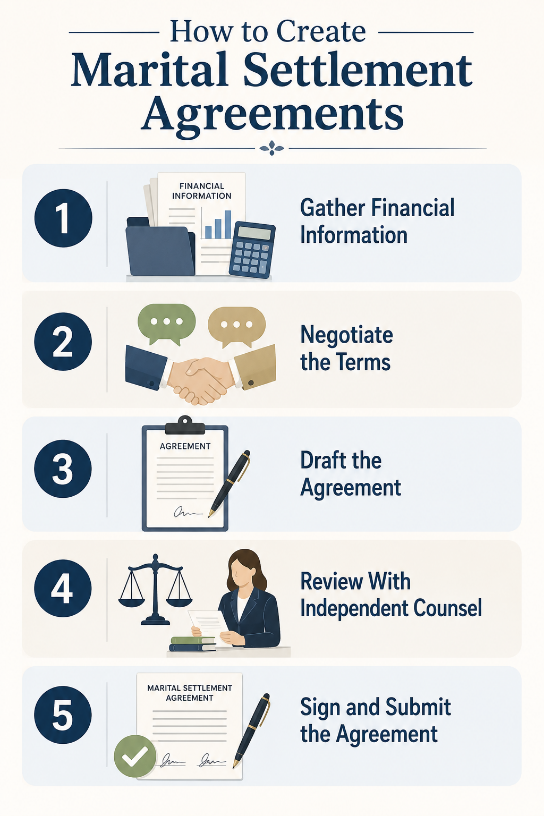
Gather Financial Information
The first step is ensuring that both spouses have a complete understanding of the family’s finances. Important information may include:
- Bank account records
- Real estate documents
- Retirement account statements
- Investment portfolios
- Business ownership interests
- Credit card balances
- Loans and other debts
Full financial disclosure is critical. Failure to disclose assets or liabilities can create legal problems and may result in portions of the agreement being challenged later.
Negotiate the Terms
After financial information has been exchanged, the spouses can begin negotiating the terms of their settlement. Negotiations may occur through direct discussions between spouses, attorney-assisted negotiations, divorce mediation, or collaborative divorce processes. The objective is to resolve all outstanding issues before finalizing the agreement.
Draft the Agreement
Once the parties reach an understanding, the terms should be drafted into a clear and comprehensive written document. A well-prepared agreement typically addresses the following issues:
| Divorce Issue | Matters Addressed |
|---|---|
| Property Division | Allocation of marital assets and debts |
| Alimony | Amount, duration, and payment terms |
| Child Custody | Legal and physical custody arrangements |
| Parenting Time | Parenting schedules and holiday plans |
| Child Support | Support obligations and payment details |
| Retirement Assets | Division of pensions and retirement accounts |
| Insurance | Health and life insurance responsibilities |
| Taxes | Filing status and dependency exemptions |
Clear language is essential because ambiguous provisions can create future disputes and enforcement issues.
Know more – Equitable Distribution in New Jersey Divorce: How Courts Divide Property and Assets
Review With Independent Counsel
Although spouses may reach agreements independently, it is often advisable for each party to have separate legal counsel review the proposed terms. Independent reviews can help ensure that:
- Rights are protected
- Legal requirements are satisfied
- The agreement is fully understood
- Future disputes are minimized
Sign and Submit the Agreement
Once finalized, both spouses sign the agreement. The document is then submitted to the court as part of the divorce proceedings. If the court finds that the agreement was entered voluntarily, reflects adequate financial disclosure, and that any provisions affecting children are in their best interests, the agreement will generally be incorporated into the Final Judgment of Divorce.
What Makes a Marital Settlement Agreement Legally Valid?
New Jersey courts generally enforce settlement agreements when certain legal requirements are satisfied. Key factors include:
Voluntary Agreement: Both spouses must enter the agreement willingly and without coercion, threats, or undue pressure.
Full Financial Disclosure: Each spouse should provide accurate information regarding income, assets, debts, and financial obligations.
Mutual Understanding: Both parties should understand the terms and consequences of the agreement before signing.
Fairness: While courts generally uphold negotiated settlement agreements, they may decline to enforce provisions that are unconscionable or were obtained through fraud, duress, coercion, or significant nondisclosure.
Protection of Children’s Interests: Any provisions involving child custody, parenting time, or child support must serve the best interests of the child.
How Are Marital Settlement Agreements Enforced?
Once incorporated into a divorce judgment, a Marital Settlement Agreement generally functions as both a binding contract and a court order. This dual status provides significant legal protection. If one spouse fails to comply with the agreement, the other spouse may ask the court to enforce its terms.
Depending on the circumstances, courts may award attorney’s fees, order compliance, enter wage garnishment orders, direct property transfers, or impose other appropriate remedies. For example, if a former spouse fails to make required alimony payments, the court may order enforcement measures to secure payment.
Can a Marital Settlement Agreement Be Modified?
Certain portions of an MSA may be modified after the divorce if circumstances substantially change.
Commonly Modifiable Provisions
The following issues may be subject to future modification:
- Child custody
- Parenting time
- Child support
- Certain alimony obligations
Examples of substantial changes may include job loss, serious illness, significant changes in income, or relocation affecting parenting arrangements.
Generally Non-Modifiable Provisions
Property division provisions are typically final once the divorce is completed. Courts rarely reopen equitable distribution terms unless exceptional circumstances exist, such as fraud, concealment of assets, duress, or mutual mistake.
When Can a Court Refuse to Enforce an Agreement?
Although New Jersey courts generally favor settlement agreements, enforcement is not automatic in every situation. A court may set aside or decline to enforce some or all of an agreement if there is evidence of fraud, misrepresentation, undue influence, coercion or duress, unconscionable terms, or failure to disclose significant assets. The party challenging the agreement typically bears the burden of proving why enforcement should not occur.
Ensure Your Agreement Works for You
A Marital Settlement Agreement can provide a practical and efficient path through the divorce process. By addressing issues such as property division, alimony, child custody, and support obligations, spouses can retain greater control over their future while avoiding unnecessary litigation.
The decisions you make during divorce can affect your family and finances for years to come. New Jersey Divorce Attorneys is here to help you navigate the process with confidence and clarity. Call +1 (973) 318-3731 today to learn how we can assist with your Marital Settlement Agreement.