
Quick Summary
Choosing between legal separation and divorce in New Jersey can directly affect how your marriage is legally recognized. It can also impact the procedural steps required to address finances, property, and custody. Separation gives you flexibility and the option to reconcile; divorce, on the other hand, permanently ends your marriage, finalizes the division of assets, spousal support, and custody, and allows you to remarry.
Legal separation vs divorce New Jersey cases are two distinct legal processes, each with different implications. Legal separation allows spouses to live apart and establish financial and parenting arrangements without ending the marriage. Divorce, in contrast, fully dissolves the marital relationship and legally permits remarriage. Most couples face important choices when deciding between these two paths, as both can have significant effects on their future. Taking the right course of action can determine how the associated obligations are structured.
New Jersey Divorce Attorneys can provide insight into how these decisions shape long-term plans and guide individuals through the process.
When a Marriage Leads to Separation or Divorce
Marital difficulties that prompt spouses to consider formal legal options often involve ongoing conflicts, financial strain, or changes in family responsibilities. Couples may struggle with cohabitation due to incompatible lifestyles, work demands, or relocation, making day-to-day life together challenging. Parenting challenges, such as disagreements, can also motivate spouses to seek clarity and restructuring.
As a result, legal separation vs divorce in New Jersey serves as a transitional step while couples evaluate the best long-term solution.
Legal Separation Defined Under New Jersey Law
In New Jersey, legal separation is not recognized as a formal marital status. Instead, couples create a separation through legal mechanisms that allow them to live apart while structuring obligations and responsibilities.
A separation agreement:
- Specifies financial obligations, including support and property management
- Establishes custody and visitation arrangements for children
- Requires full financial disclosure and voluntary consent by both spouses
- Can be modified if reconciliation occurs
- Is a court-issued judgment allowing spouses to live apart and formalize support and custody obligations
- Does not dissolve the marriage or permit remarriage
- Provides a structured framework for managing responsibilities while maintaining the marital relationship
This arrangement provides a structured framework for managing financial and parental responsibilities while maintaining the marital relationship, and it can serve as a transitional step for couples considering a permanent resolution.
Divorce Defined Under New Jersey Law
Divorce, also known as absolute divorce, legally ends a marriage and resolves all associated obligations. The process finalizes the division of property, determines spousal support, and establishes custody and visitation arrangements. Once the divorce is granted, both spouses regain the legal ability to remarry and are released from marital responsibilities.
This formal dissolution provides a definitive framework for managing financial obligations and parental responsibilities.
Financial Responsibilities Shift Between Separation and Divorce
During a separation agreement or a divorce from bed and board, spouses can negotiate temporary arrangements that provide flexibility while preserving certain benefits. In contrast, an absolute divorce triggers a permanent division of marital assets and debts under New Jersey’s equitable distribution laws.
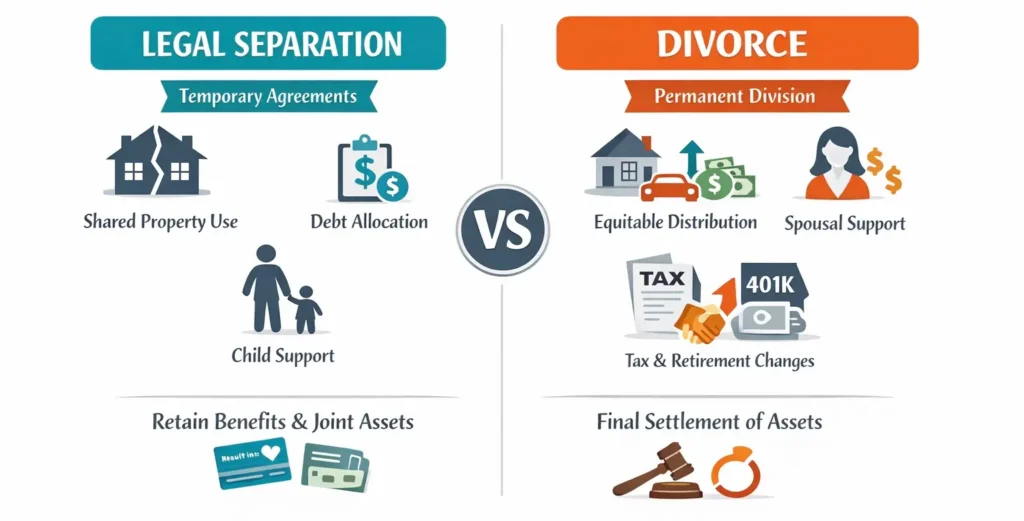
For this reason, courts also determine alimony, spousal support, child support, and adjustments to retirement, tax, and insurance benefits. These factors outline a major difference between separation and divorce NJ.
Timeline And Reversibility Of Legal Separation And Divorce
A separation agreement or a divorce from bed and board in New Jersey can be implemented either when the parties agree to the terms or when a court enters a judgment. Because the marriage remains legally intact, these arrangements can be modified. Courts have jurisdiction to adjust spousal support, child support, and custody or parenting time in the event of a material change in circumstances.
Absolute divorce involves a formal court process, including filing, discovery, and hearings. Once finalized, the marital status is permanently dissolved. Post-divorce modifications are limited to financial support and custody matters. Spousal support can be changed if circumstances materially change, and child support can be updated based on income or the children’s needs. Property distribution in an absolute divorce is generally final and can be altered only in limited circumstances. Legal separation vs divorce in New Jersey is a critical matter, and thorough consideration is crucial.
Factors Influencing the Choice Between Separation and Divorce
When considering which legal course to pursue, individuals must understand the difference between separation and divorce in NJ and evaluate several practical factors carefully. One consideration is whether they want to maintain marital benefits, which remain in effect during a separation. Personal or religious preferences to stay legally married may also guide the choice.
Individuals also assess their readiness for permanent dissolution. Divorce ends the marriage legally and carries long-term financial and custodial consequences, whereas separation allows for temporary arrangements. The possibility of reconciliation may also be a factor. Separation provides the flexibility to adjust or terminate agreements if circumstances change, while divorce is permanent. Considering these elements helps someone select the option that aligns with both their priorities and New Jersey legal requirements.
Final Word on Separation and Divorce Differences
Deciding between legal separation vs divorce New Jersey requires careful consideration of the procedural differences, long-term implications, and personal circumstances of each spouse. Legal separation offers a structured way to manage financial obligations, property usage, and parental responsibilities while maintaining certain marital benefits, and it allows for adjustments over time as situations change. In contrast, divorce permanently dissolves the marriage, finalizes the division of assets and debts, and establishes definitive spousal support and custody arrangements, providing clarity but leaving little room for modification.
When weighing these options, it is important to reflect on factors such as eligibility for marital benefits, emotional readiness for permanent dissolution, and the complexity of financial and parental responsibilities. An informed understanding of each option helps clarify the rights and obligations of both parties.
If you want to explore how these legal processes work, you may speak with New Jersey Divorce Attorneys for general guidance. You may call (973) 318-3731 or visit the Contact Us page for additional information.
FAQs
How much alimony am I required to pay in New Jersey?
New Jersey law calculates alimony based on factors such as income, earning potential, duration of marriage, age, health, and lifestyle established during the marriage. Formulas exist for temporary and indefinite support, but the final amount is determined by the court’s equitable assessment of both spouses’ financial circumstances, obligations, and needs.
Do children’s preferences determine custody in New Jersey?
Children’s preferences are one factor in New Jersey custody decisions, usually considered when the child is of sufficient age and maturity. Courts prioritize the child’s best interests, evaluating emotional needs, stability, parental relationships, and each parent’s ability to provide care, rather than automatically granting custody based solely on the child’s choice.
How soon can I remarry after a divorce in New Jersey?
Once a divorce is finalized, there is no required waiting period. Both parties are legally free to remarry immediately, as the court’s judgment fully dissolves the marriage and ends all marital obligations. Any previous legal ties from the marriage, including spousal responsibilities, are terminated upon finalization. This is one of the critical elements between legal separation vs divorce New Jersey.