
Quick Summary
If you’re going through a divorce, your marital property and assets will be divided through equitable distribution in the New Jersey divorce process. You’ll provide financial disclosures that the court reviews while considering factors like income, contributions, and marriage duration. This ensures a fair division of the marital estate.
Dividing property is one of the central legal issues in a divorce. State law uses a framework called equitable distribution New Jersey divorce process to determine how marital assets and debts are allocated between spouses. Instead of relying on a strict equal split, courts evaluate the financial history of the marriage and determine what distribution is fair under the circumstances. This approach recognizes that spouses may contribute to a marriage in different ways, whether through income, managing the household, or supporting a partner’s career. Because each marriage is financially unique, property division often requires careful analysis of records, ownership history, and the role each spouse played in building the marital estate.
New Jersey Divorce Attorneys can help individuals understand how equitable distribution works within the divorce process, explain how courts examine financial disclosures, and review the factors that influence division decisions.
Understanding Equitable Distribution Under New Jersey Law
Equitable distribution is the legal principle that governs how property and debts are divided during a divorce in the state. The rule is established under property division NJ divorce law and reflects the view that marriage functions as an economic partnership. Both spouses may contribute to the growth of marital property, even when those contributions take different forms.
The court’s goal is to achieve fairness, not strict numerical equality. Judges consider the full context of the marriage when deciding how to divide assets and debts. This method enables the court to account for the unique circumstances of each relationship instead of relying on a predetermined formula.
In practice, equitable distribution in New Jersey divorce requires a careful review of property ownership, financial contributions, and the economic conditions of both spouses at the time of divorce. Courts review evidence such as documents, testimony, and financial records to identify marital assets and decide how they should be managed throughout the divorce process.
Definitions of Marital Property and Separate Property
Before any division occurs, courts must determine which property belongs to the marital estate. Not every asset connected to a marriage is subject to equitable distribution. Marital property generally includes assets and debts acquired during the marriage.
Common examples include:
- Marital home
- Savings accounts
- Investment accounts
- Retirement benefits earned during the marriage
- Vehicles
- Certain business interests
- Debts accumulated during the marriage, such as mortgages, personal loans, or credit card balances
Separate property is typically excluded from division. This category may include property owned before the marriage, inheritances received by one spouse, or gifts given specifically to one individual. However, separate property can lose its protected status if it becomes mixed with marital assets. Courts review financial records closely when determining whether commingling has occurred.
How Equitable Distribution Influences the Divorce Case
Equitable distribution is closely connected to several stages of the divorce case. The issue begins to take shape early in the proceedings and continues to develop as financial information becomes clearer.
Property issues can influence negotiation strategies and other legal decisions. In some situations, disputes about property classification or valuation can extend the timeline of a divorce case. When children are involved, housing arrangements may also become relevant, particularly when considering whether one spouse will remain in the marital home.
Many people consult a family lawyer early to better understand how property and assets are handled during a New Jersey divorce.
The Process Courts Follow When Dividing Property
Equitable distribution in New Jersey divorce typically follows a structure that unfolds during the case. While each situation differs, courts generally work through several key steps before issuing a final decision.
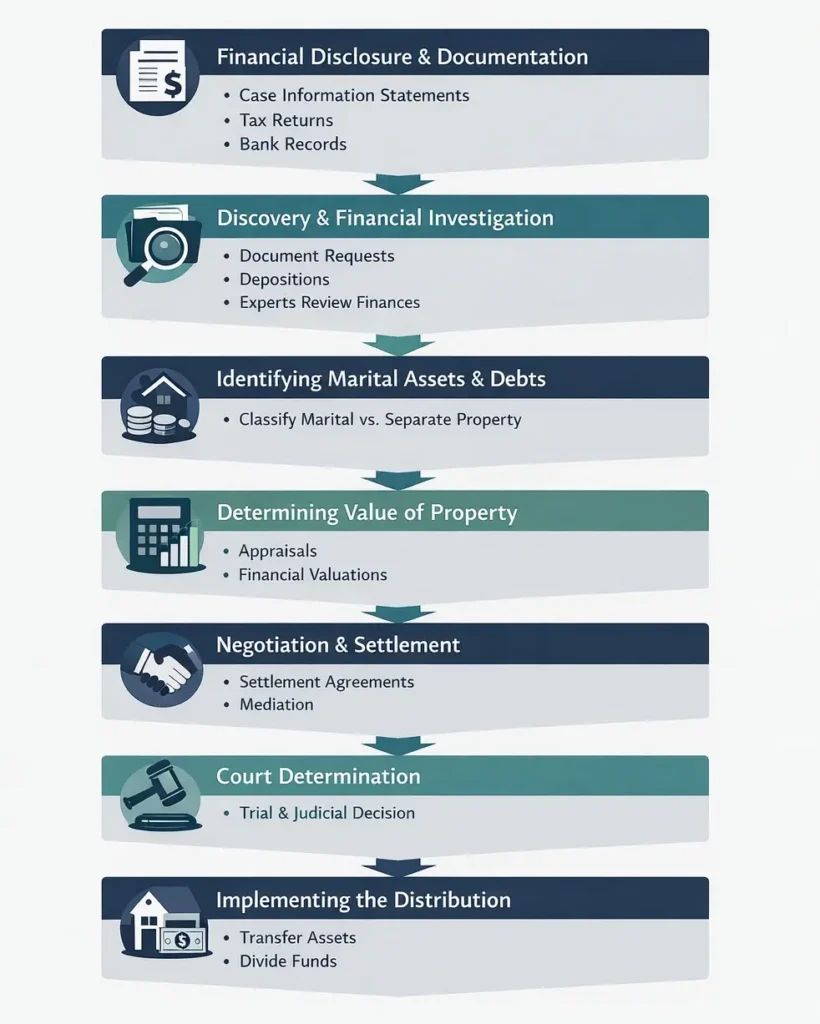
The Process Begins with Financial Disclosure
Each spouse must provide a detailed statement outlining income, expenses, assets, and debts. In New Jersey, this information is commonly presented through a Case Information Statement (CIS). These disclosures help the court understand the financial structure of the marriage.
Supporting documentation may include:
- Tax returns
- Bank account statements
- Investment records
- Loan statements
- Property deeds
- Retirement account summaries
Discovery to Investigate More Financial Information
After the initial disclosures are filed, either party may request additional information through discovery. This stage allows attorneys to obtain documents that clarify financial questions or resolve disputes.
Discovery may involve:
- Written interrogatories (formal questions)
- Requests for financial documents
- Depositions under oath
- Review by financial experts such as accountants or appraisers
This step helps ensure both parties are working with the same financial information before negotiations or hearings proceed.
Identifying Marital Assets and Possible Debts
Once financial information is gathered, the court determines which property belongs to the marital estate. This often requires reviewing financial timelines and records.
Property acquired during the marriage is usually considered marital, but questions may arise when:
- Assets were partially acquired before marriage
- Separate funds were used to purchase marital property
- Property was transferred or commingled during the marriage
Courts examine timelines, financial records, and account histories to resolve these issues.
Determining the Value of Marital Property
After identifying marital property, the court must determine the value of each asset and debt. Establishing value ensures that the distribution process reflects the parties’ actual financial positions.
Real estate may require a professional appraisal, while retirement accounts are often evaluated based on account statements. Business interests may involve a detailed financial analysis to determine market value. Accurate valuation helps prevent disputes and supports fair decision-making.
Negotiation and Settlement Discussions for Division
Once assets and values are established, spouses often attempt to negotiate a settlement. These discussions may occur directly between attorneys or through mediation programs designed to help parties reach an agreement.
When a settlement is reached, the terms are documented in a Marital Settlement Agreement. This agreement outlines how property and debts will be divided and becomes part of the final divorce judgment after court review.
Court Determines Action When Disputes Remain
If negotiation does not resolve the property dispute, the issue may proceed to trial. During trial, each party presents evidence regarding the marital estate and the proposed distribution of assets and debts.
Judges consider a number of statutory factors when deciding how property should be divided. These factors may include the duration of the marriage, the economic circumstances of each spouse, their earning capacity, and the contributions each made to the marital partnership.
Implementing the Final Distribution of Marital Property
After the court finalizes the property division in an NJ divorce, the terms must be implemented. Implementation may involve transferring property ownership, refinancing loans, or distributing funds from retirement accounts through legal mechanisms such as qualified orders.
This stage converts the court’s decision into practical financial changes. Once completed, the distribution terms become part of the final divorce judgment.
Closing Note on Equitable Distribution in New Jersey
Equitable distribution plays a central role in divorce cases because it determines how marital property and debts are allocated. The equitable distribution New Jersey divorce process is designed to address the financial realities of different marriages. Because courts consider a wide range of factors, the system can accommodate households in which spouses play different economic roles. The system follows a structured method for reviewing complex financial situations. By requiring documentation, valuation, and legal review, equitable distribution creates a framework that helps courts address disputes involving real estate, investments, retirement accounts, or business interests. This ensures fair allocation of the marital estate.
For individuals navigating these issues, New Jersey Divorce Attorneys may provide guidance on how equitable distribution fits within the broader divorce process and how courts evaluate property disputes under state law. If you have specific questions, you may Contact Us or call our number (973) 318-3731.
FAQs
What if I cannot provide all the required financial documents for equitable distribution?
Financial disclosure is essential for equitable distribution New Jersey divorce process. If you cannot provide specific documents, the court may allow extensions, consider alternative evidence, or request affidavits. Failing to provide necessary records can delay proceedings or result in assumptions about missing assets, potentially affecting the division of property and debts in your divorce.
Will I be responsible for my spouse’s debts after divorce?
In New Jersey, debt responsibility depends on whether it is marital or separate. Marital debts, such as joint loans or obligations incurred during the marriage, may be split fairly. Separate debts, including those acquired individually before the marriage or after filing for divorce, generally remain with the spouse who incurred them.
What happens if my ex-spouse gets the marital home?
If the court grants the marital home to your ex-spouse, you may be required to transfer your ownership interest or allow a buyout. Courts may also adjust other assets or debts to balance the distribution. Your financial responsibility for the property depends on the judgment and whether any mortgages or liens remain in your name.